
Why Builders Request Construction Staking Surveys Before Breaking Ground on New Homes
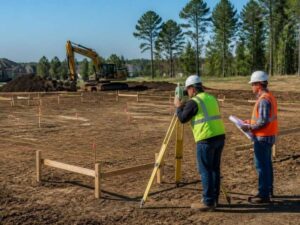
A new home starts as lines on paper. Someone still has to put those lines on real dirt. A construction staking survey does that job. It marks where the house sits on the lot before any digging begins.
Builders ask for it for one plain reason. They want the home in the right spot the first time. A wrong placement costs money and time. It can even mean tearing out a poured slab. Stakes on the ground give the crew a clear target from the start. That target is what this whole article is about.
How Construction Staking Helps Builders Place a Home Correctly
Construction staking turns the site plan into marks you can see and touch. A surveyor reads the approved plans. Then they place stakes that show where the home belongs on the lot.
Those marks point to the parts that matter most for a house:
- the building corners
- the setback lines from each property edge
- the garage, porch and driveway edges
- key elevation or grade points from the plan
Each stake ties back to a measured point on the drawing. The crew doesn’t guess. They build to the marks.
The corners carry the most weight. They fix the shape and angle of the house on the lot. Once the corners are set, the crew can string lines between them and see the real footprint. The setback stakes matter almost as much. They prove the home keeps the required distance from each line. A builder can stand on the lot and confirm the fit before spending a dollar on excavation.
Placement sets the tone for the whole job. Get the corners right, and the foundation, framing and utilities line up behind them. Start a few feet off, and every step after that inherits the same mistake. That’s why builders treat staking as the first real move on site.
What Building Problems Can Happen Without Accurate Staking?
Skip careful staking, and the house can end up in the wrong place. Maybe it sits too close to a side line. Maybe it crowds a setback the county requires. Maybe it shifts toward one corner of the lot and leaves no room for the driveway.
Small location errors grow fast. A foundation poured a few feet off can break a setback rule. Now the builder faces a stop-work order, a variance request or a tear-out. Each option burns weeks. Each one also costs cash the budget never planned for.
Spacing problems hurt too. A home placed wrong can sit too near a neighbor, a well or a utility line. It can block the path a future driveway needs. It can push the septic field into ground that won’t work. Fixing any of that after concrete cures is slow and costly.
There is a quieter cost as well. When the crew isn’t sure where the house goes, they slow down. They measure, argue and wait for answers. That lost time adds up across a build.
The cheapest time to catch these errors is before the excavator arrives. Stakes let the builder check the plan against the real lot while dirt is still easy to move. A mistake on paper costs minutes. The same mistake in a footing costs far more.
How Surveyors Support Builders Before Foundation Work Begins
Before foundation work begins, a surveyor checks the plan against the real lot. Lots rarely match the plan perfectly. Trees, slopes, old fences and odd corners all show up in the field.
The surveyor confirms the home clears each setback. They flag spots where the design and the site don’t agree. Maybe a corner lands on a steep bank. Maybe the plan ignores a drainage low spot. Catching that early gives the builder time to adjust, not scramble at the last minute.
The surveyor also leaves reference points the crew can trust. These are fixed marks the excavator and foundation team use to line up their work. Some sit off to the side, away from the dig, so they survive the first pass of the machines. When the first cut of dirt starts from a known point, the rest of the build has a solid base. Crews waste less time measuring and re-measuring on their own.
When Should Builders Schedule Construction Staking?
Staking belongs early in the build, after the lot is cleared and rough-graded but before excavation. The crew needs those marks in place before they dig the foundation. Booking it late can stall the whole schedule. The excavator shows up, finds no marks and stands idle.
Timing matters for a second reason. A surveyor stakes from the plans the builder hands them. If those plans change after staking, the marks may no longer match. Then the survey has to be redone. So builders should lock in the current approved plans first. Then they call for staking.
A simple rule works well. Have the final site plan and house plans ready, confirm the lot is prepped, then book the survey a few days ahead of the excavator. That small buffer leaves room to fix any conflict the surveyor spots before machines show up. It also gives the survey crew a window if weather or a busy schedule pushes the date.
How Construction Staking Can Keep New Home Projects on Track
Clear stakes keep everyone building from the same page. The excavator, the foundation crew and the framer all read the same marks. No one has to interpret the plan alone or argue about where a wall goes. The marks settle it.
Staking also opens a clean line of talk between the builder and the surveyor. If the surveyor finds a problem, the builder hears it before it becomes concrete. If the plan updates, the surveyor can re-stake the affected points. That back-and-forth keeps small issues from turning into big ones.
The payoff is steady progress. Fewer location errors mean fewer surprises. Fewer surprises mean the crew keeps moving instead of stopping to fix a slab. For a builder running several homes at once, that kind of predictable start earns back the survey many times over.
For a free land surveying quote, call us at (703) 854-9783 or send us a message by going here.
Posted in land surveying, land surveyor | Tagged Construction Survey